Monday, August 1, 2011

Portugal and Green a Great Wine is made Vinho Verde

   In Portugal 60% of the wine made is red, rose and fortified, and 40% of wine made is white.  Besides Port, I think one of Portugal's great contribution to wine is their Vinho Verde.  Vinho Verde means Green Wine, don't worry the wine isn't green.
   But before I get too far into the Vinho Verde white wine let me back up and tell you more about the region Vinho Verde.  Vinho Verde is the largest DOC region in Portugal.  It covers the entire northwestern corner.   
    Let's talk about the wine Vinho Verde.  There is a red Vinho Verde, it has a lot of tannins and goes well with their local sea food.  From here on out when I write Vinho Verde I will be referring to the white wine, mainly because it is the only one I have had and most likely the only one you can find in the US.  The terroir is manly a granite soil, and with the cool weather a "..crisp, minerally Vinho Verde.." is produced.  Vinho Verde is meant to be consumed young.  In some places there will not be a vintage on the bottle which usually mean it is from the previous years harvest.  The wine is dry (no sugar) with a slight fizz.  Vinho Verde is often described as "searing high levels of acidity", when exported the wine is usually sweetened a bit to hide the acidity.  The alcohol content is low 8.5 - 11.5%.
    The wine is made from a field blend, a combination of about 25 different grapes, with Loureiro and Trajadura being the two most popular.  The wine can be  made with one of those grapes or any combination.  This wine started out as wine that the farmers would make for themselves with whatever grapes that they have.
    I had the Twin Vines Vinho Verde.  It is on the acidic side.  The slight fizz helps balance out the acidity.  I personally enjoy the acidity (almost a sour taste), and the strong flavors.  It is great on a hot summer day when there is bit of humidity, while sitting by the pool.  It is a fun wine to try.  Even if you don't like you have now tried a new kind of wine and have learned something new.
Enjoy!

photo from : http://www.jmftwinvines.com/about-twin-vines-wine.html
information from: no auther, consultant Susan Keevil (2010). Wines of the World.  New York NY, Metro Books.
     originally published by Dorling Kindersley Limited in 2004
   Given to me by my mother and father in law

Labels: , ,

Friday, July 29, 2011

What Does Costco/ Kirkland have to Offer for Wine

    Well it has a lot to offer.  Their Zinfandel received 88 points from Wine Spectator.  Today I am writing about their Pinot Grigio.  It is their 2010 from Friuli Italy, and it is only $6.99.
    The wine is a nice light green color.  Its nose is bright lime and citrus.  It almost smells like a fresh cool summer day.  The wine has a nice warm flavor with a clean finish.  These flavors come through when the wine has been out of the fridge for a while.  When the wine is cooler it is more refreshing wine, great for a hot day.  There is a real crispness to it than.  The wine leaves a lingering citrus flavor, the finish.
    What I would like to leave you with has not as much to do with this wine, but to give the Kirkland brand a chance.  Not all of them will be amazing.  Some will be good for their price, but not great.  But there are some really great ones out there.  Give them a chance, and let me know what you think.
Enjoy!


photo from http://costcowineblog.com/2011/06/04/2010-kirkland-signature-pinot-grigio-friuli.aspx

Labels: , , ,

Tuesday, July 26, 2011

Moscato Vs. White Zinfandel

   I never thought I would be writing about white zinfandel, but then again I never thought I  would be writing about Burgundy wine in a box (Burgundy and Box Wine).
    Barefoot is well known brand.  It is pretty easy to find their small and big size bottles, and the regular size bottles are just about everywhere.  I find Barefoot makes pretty good white wines, especially sweet white wines.  I decided to try their white zinfandel and moscato.  Moscato is a sweeter wine that is usually found as either a semi-sweet table wine or a desert wine.
   So what is the difference between the Barefoot, White Zinfandel and Moscato, besides being a different grape?  A white zinfandel is a rose wine and a Moscato is white wine.

Nose: sugary  
      WhiteZin: a hint of a berry fruit in a dessert
      Moscato: almost like a sugar cookie

Color:
      WhiteZin: pink or blush color
      Moscato:  light straw color

Taste: no tannins or acidity
      WhiteZin: a light sweetness, fruit flavors with a mild light green flavor at the finish;  a slight clean  finish; light mouth feel
      Moscato:  very sweet, from the front of the mouth all the way to the back; heavier mouth feel

For people that like a sweet wine I would recommend the Moscato.  I find some white zinfandel's can have a specific finish (the green flavor), if you are a fan I would recommend the Barefoot.  I don't think I have ever tasted a bad white zinfandel (and by bad I mean it doesn't fit what it should taste like not bad because you don't like the way it taste), if you have found a white zinfandel to stay away from let me know.  I will have to try it and write about it.  I have also heard the Barefoot sparkling wine is good.  It is on my list of wines to try.
Enjoy the wine!

Labels: , , , ,

Thursday, July 7, 2011

What a Conundrum

    I was at a BBQ a few nights ago and had a white wine called Conundrum (2009).  I have heard good things about this wine.  It was first made in 1989 by Wagner Family of Caymus Vineyard.  The name Conundrum was given because when you try and figure out what grape(s) the wine is made of it feels like a "conundrum".  So you don't have to struggle with this "conundrum"  I will tell you what the wine is made of ( I am so nice ).  The primary grapes are Sauvignon Blanc, Chardonnay, and Muscat Canelli; with a little of Sémillon and Viognier. 
      Here though is my "conundrum",  why don't I like this wine?  I have read many customer reviews that talk about the wonderful fruit flavors, and smoothness.  I get the fruit, I taste the melon and peach, but not the smoothness.  It stung the back of my throat.  I read on the conundrum website (see below) that the wine is lightly aged in oak barrels.  I personally don't like oak aged Chardonnay [a clue?].  They do this to add a slightly vanilla flavor.  This might be what is causing some of that sensation.
    The other idea is that maybe the newer vintages are not as good as the older vintages.  In 2007 the wine production moved to Monterrey County.  Also around this time Caymus came off of the label and Conundrum became its own brand.  This might have something to do with it.  
      I wouldn't try it again for $20.  If I found it cheaper I would try it again with some different food.  The right paring can really make a big difference.  If you have tried Conundrum let me know what you think, and if you found a dish that it pairs great with definitely let me know.


http://www.conundrumwine.com/

Labels: , , , ,

Monday, July 4, 2011

Roman Empire, racing horse and Pinot Grigio

      Last night I went out for my birthday dinner with my family.  We had a great time.  Usually I am involved in picking out the wine to drink, but my parents got to the restaurant ( http://www.eulipia.com/ ) before I did so they picked out a Pinot Grigio.  I appreciate a good Pinot Grigio, however I do not usually drink them.  The only reason is because personally I do not enjoy the mineral flavor (not that it is bad, just not my thing), which can be common in Pinot Grigio.  However I really enjoyed this bottle.

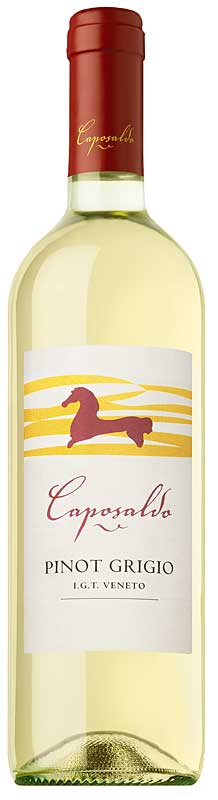
     We had a Caposaldo Pinot Grigio from Veneto, Italy.  My dad described it as fluffy.  The mouth feel really has a fluffy feeling on the tongue (my dad was right).  This bottle was well balanced, there was the acidity to cut through the sweetness (given by alcohol and fruit flavors), but the acidity is not to high that it is sharp.     I would highly recommend this wine.  Caposaldo also makes a Chianti and Prosecco
  
"Caposaldo is named in memory of the Roman Empire's most famour [famous] racing horse.   Competing for an astounding 24 years and winning 1,500 of his over 4,000 races, the horse gained the favor of Emperor Nero, who anointed the horse "Caposaldo" and immortalized him in the form of a brooch for his love, Sabina.   This is the image you see today on the Caposaldo wine label."
 ( photo and quote from http://perrylpayne.com/Wine/Wine_Caposaldo.htm )


Every day I learn something new, today it is about the Roman Empire's famous race horse.  If any of your knew about this before you read this I am very impressed by your Roman Empire horse racing knowledge 

http://www.kobrandwineandspirits.com/products/view_factsheet.php?c=cap000


Labels: , ,

Thursday, June 30, 2011

Bordeuax vs. Meritage

      A Bordeuax wine can be either red or white.  The red wine must be made from at least two of these grapes, with no single varietal being more then 90%: Cabernet Sauvignon, Cabernet Franc, Malbec, Merlot, Petit Verdot, St. Macaire, Gros Verdot and Carmenère.  It can not contain any grape that is not on this list.  The rules are the same for white wine with these varietals: Sauvignon Blanc, Semillon and Muscadelle du Bordelais.

       A Meritage is pounced just like heritage but with an M in front.  According to the Meritage Alliance a meritage is a blend that of at least two grapes, with no single grape being more then 90%.  The grapes varietals that can be blended are:

A red meritage: Cabernet Sauvignon, Cabernet Franc, Malbec, Merlot, Petit Verdot and sometimes St. Macaire, Gros Verdot and Carmenère.

A white meritage: Sauvignon Blanc, Semillon and Muscadelle du Bordelais.

No other grape can be used.

      Bordeuax and a Meritage almost the same with one big difference.  A Bordeuax must be from Bordeuax, France, if it is made one yard outside of the Bordeuax region it is not longer a Bordeuax.

     But what about Meritage, does that have a region restriction? It must be made in the US.  US is a new world wine region.  I will continue to do research on how Meritage is used in both new world and old world wine regions, and will let you know what I find.

Labels: , , , , ,

Monday, June 27, 2011

The first blog - Vidal Blanc and Massachusetts

Hello All,

    This wine blog is not only a review of wine but also the stories behind them.  I will be writing about different grapes, wineries and other fun facts and stories. Today I am writing about Massachusetts wine, and the Vidal Blanc.
        Vidal Blanc is a white grape most predominantly used in Canada and northeastern US.   It is a hybrid of Ugni Blanc and Rayon d'Or. It was developed by a French breeder Jean Louis Vidal in the 1930's.  Vidal Blanc is grown in cold climates. It has a high sugar level well also having good acidity levels.   This makes it a great grape for Ice Wine and dessert wine.
        Massachusetts is not well know for its wineries but it has been producing wine since 1971 with the opening of Chicama Vineyards  (no longer around).  Currently there are 27 wineries in Massachusetts.  Vidal Blanc is a popular grape in Massachusetts simply because is does very well in cold climate.  The grape is also used to make table white wine, which is what I tasted.
The last time I was in Massachusetts I picked up a bottle of Vidal Blanc


Running Brook Vineyards -  Vidal Blanc 2007 - Southeastern New England

     Going into the first taste I had no idea what to expected.  For the first sip I was slightly startled by how sweet it was.  During the second sip I noticed how the flavor changed throughout the sip.  It started sweet with an acidic finish.  I wish it was better blanced with the sweetness and the acidity working together not against each other.  I am sad to say I did not love this wine.
    I have not given up on Vidal Blanc.  I will keep my eye out for another one to try.  If you have  come across a Vidal Blanc comment back, if you found one you enjoy definitely let me know what it was so I can give it a try.

Labels: , ,